Some words
Hi! I recently completed an MPhys in Physics at the University of Edinburgh, graduating with First Class Honours. I will begin a PhD in Physics at the University of Cambridge in October 2026, working in Pietro Cicuta's group. My current interests lie mainly in biological physics and active matter, particularly collective ciliary dynamics, chromatin organisation, transcriptional dynamics, and the ways living systems process and store information.
Prior to these questions, my physics journey has taken me through several parts of physics. Earlier projects in quantum magnetism and neutron scattering introduced me to experimental research and microscopic modelling, while work in statistical physics, bacterial turbulence, and chromatin dynamics drew me increasingly toward collective behaviour in living systems. I value being able to approach unfamiliar problems from different directions, and I hope to keep that breadth as my research develops.
I am deeply grateful to my research supervisors, Chris Stock , Alexander Morozov , Davide Marenduzzo , and Pietro Cicuta . Their guidance helped me develop as a researcher and gave me the confidence to explore fields that were once entirely new to me. I am equally grateful to the friends and collaborators whose questions, conversations, and encouragement continue to shape how I think.
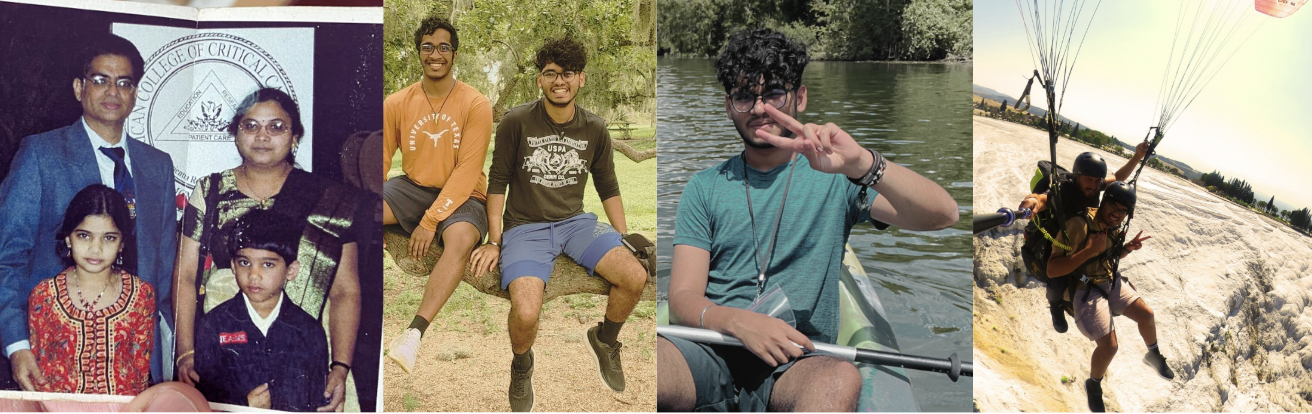
I would also like to think that I am more than my Google Scholar page . I grew up in Trinidad and Tobago, and I have been very fortunate in the opportunities available to me. Much of that is thanks to my family . My parents and sister have always encouraged my curiosity and supported me, both emotionally and financially, while giving me the freedom to pursue what I love.
Outside physics, I enjoy playing cricket, attempting to improve at chess, solving various Rubik’s cubes, swimming at the beach, and writing. Those hobbies sometimes take a back seat when research becomes busy, although science writing gives me a way to connect several of them. I have particularly enjoyed writing about fusion energy and the crisis in cosmology for Edinburgh University Science Media.
I know that I have been fortunate. Many people who work just as hard are denied the same freedom and opportunity by poverty, inequality, war, and discrimination. I therefore feel a responsibility to make the most of what I have been given. John Keats worried that philosophy—and, by extension, science—could “unweave a rainbow,” taking some of the mystery from the world. To me, science removes one mystery only to reveal deeper and more beautiful questions. It should help us understand both nature and society, and ultimately improve life for as many people as possible.
Whatever path I follow, I hope that in some small way I can contribute to a society in which everyone has the freedom to explore what they love and discover who they want to become, regardless of the circumstances of their birth. To recall the words of Aimé Césaire, often quoted by the Trinidadian writer C. L. R. James:
“…there is a place for everyone at the rendezvous of victory.”
Aimé Césaire